Ovens, ranges and steam ovens
Thermador oven that will not hold its setpoint
Wall ovens, dual-fuel and all-gas ranges, steam and speed ovens — ignition, element, control and door hardware faults.
Wall ovens, ranges and the beach kitchens they sit in
Thermador cooking equipment on this stretch of sand comes in two rough generations. In the newer construction south of Beach Boulevard it is usually a matched package that went in at one time — double wall ovens, a steam or speed oven above them, a range or rangetop and a hood. In the older cottages nearer the ocean it is a single unit retrofitted into a cabinet that was built for something narrower.
That difference changes the repair before we look at a single component, because access is half the job on a built-in oven.
Thermador oven not heating, or not holding its temperature
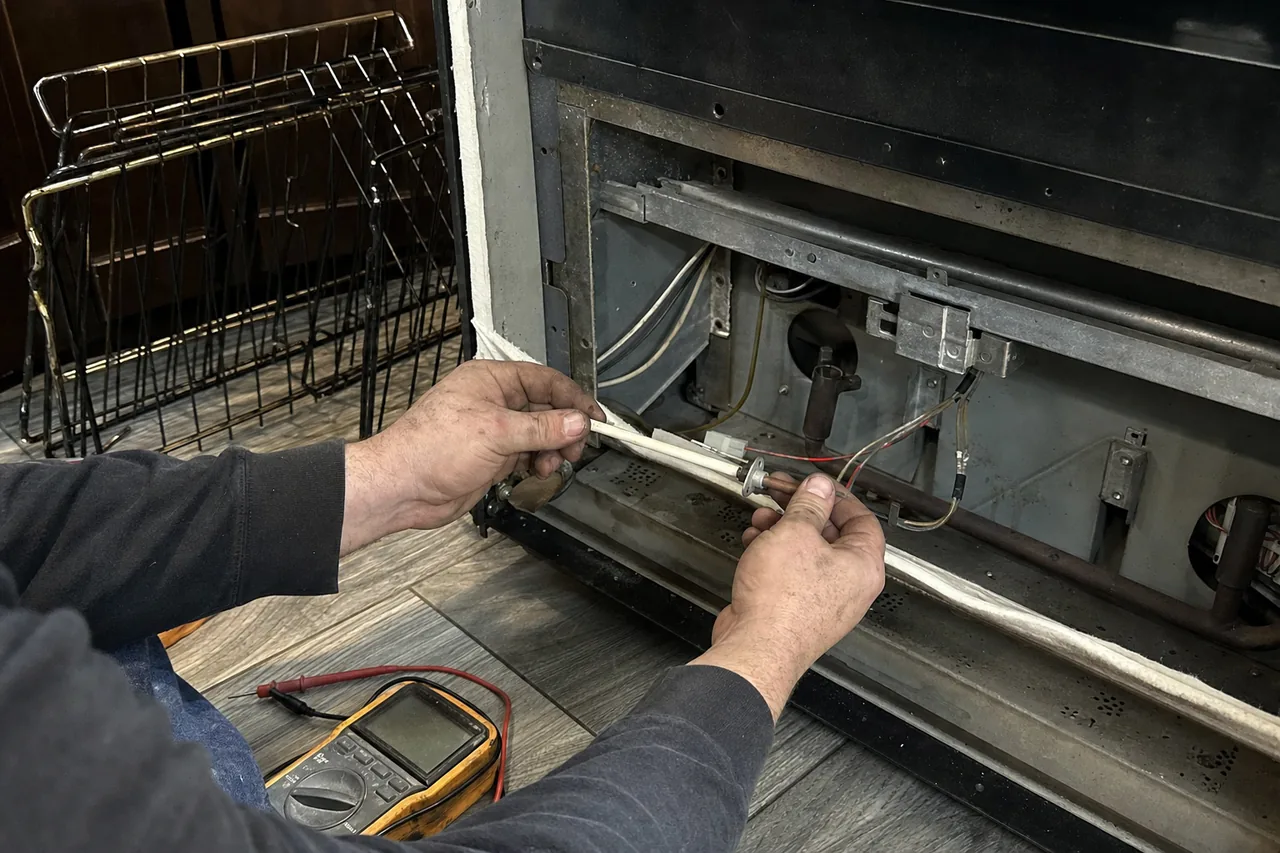
“The oven runs cold” is the most common call and the most often misdiagnosed. Before anything gets replaced we put a probe in the cavity and log actual temperature against setpoint through a full preheat and two cycles.
There are only a few honest outcomes. A bake element with a broken section heats unevenly and never reaches setpoint — you can often see the fault as a blistered or split sheath. A cavity sensor that has drifted resistance reports a false temperature to the control, and the oven obediently overshoots or undershoots by a consistent margin. A convection fan that has stopped turning leaves the top of the cavity thirty degrees hotter than the bottom, which reads as “the oven is wrong” rather than “the fan is dead”. And a door that no longer seals bleeds heat continuously, so the element never gets to stop.
Replacing a control board because an oven runs cool is the expensive way to find out it was the sensor. That is also why the bands printed further down this page are the sensor, the element and the door rather than the electronics: those are the parts an oven that will not heat actually turns out to need.
Steam and speed ovens
A steam oven is a small boiler with an oven wrapped around it, and almost everything that goes wrong with one happens on the water side rather than in the cavity.
The first question is how yours is supplied. A tank-fill unit draws from a reservoir the owner fills and empties, and its faults tend to be the level sensor, the pump that moves water to the generator, or a reservoir seal. A plumbed unit takes a permanent supply, which removes the filling chore and adds an inlet valve, a filter and a shut-off that all belong in the diagnosis. The same complaint — no steam, or weak steam — points at different components depending on which one you have, so we ask before we arrive.
The generator itself is the expensive part. A deposit layer on the element insulates it from the water it is meant to boil, so the element runs hotter to move the same energy, steam output drops, cycles stretch, and eventually the element or its thermal cutout gives up. Running the cleaning routine when the oven prompts for it is the whole of the prevention, and it is worth doing on the prompt rather than at a convenient moment.
Two more things get blamed on the generator and are not. A door that no longer seals lets steam out faster than the unit can make it, which reads as weak output. And a condensate or drain path that has partly blocked will leave water in the cavity at the end of a cycle, which reads as a leak. We check both before anything is quoted.
Ignition and gas faults on ranges
On an all-gas or dual-fuel range, a burner that clicks without lighting is usually a wet or fouled igniter rather than a gas supply problem — and in a house three blocks from the ocean, “fouled” often means salt residue and grease baked into the ceramic. A burner that lights and then drops out on low is a different story, generally a flame-sensing or gas-pressure issue.
We check manifold pressure, igniter resistance and the burner cap seating before we touch a part. Sealed-burner ports also clog with the fine grit that comes in through beach windows, and a port cleaning restores a flame pattern that looked like a failing valve.
Doors, hinges and self-clean
Oven doors carry weight, and beach kitchens are humid. Hinge springs relax, the door hangs a few millimetres proud at the top, and the gasket stops sealing. That single fault causes slow preheats, uneven baking, a hot cabinet front and self-clean cycles that abort partway through because the control sees a temperature it does not expect.
Hinge and gasket work is cheap and quick relative to what a leaking door costs in element life. We check both on every oven call whether or not it is the complaint.
What a service call covers
We diagnose the fault, put the finding in writing, and quote the repair before we order anything. Genuine OEM parts only, a flat $80 diagnostic credited toward the work, 90 days on labor and 365 days on parts.
What it costs
What does ovens, ranges and steam ovens work cost here?
The bands below are the ones this repair actually falls into — parts and labour, fitted, read off the same table the pricing page prints in full.
| What was actually wrong | Parts and labour, fitted |
|---|---|
| The visit and the diagnosis | $80 flat |
| Oven thermostat or temperature sensor | $190–$520 |
| Bake or broil element | $190–$590 |
| Door hinge, glass or seal | $190–$640 |
| Igniter, spark module or surface element | $190–$500 |
The $80 buys the visit and the diagnostic sequence, and it comes off the bill the moment you approve the work. Every row below is a range because what a part costs turns on which production revision is sitting in your cabinetry, and nobody knows that until the rating plate has been read. The whole table is on the pricing page.
Ovens, ranges and steam ovens — asked on the phone
My oven runs cold at every setting. Is the thermostat gone?
Usually not. A cavity that will not hold its setting is more often reporting a door that has stopped sealing, a temperature sensor that has drifted, or an element heating along only part of its length. We log a whole preheat against an independent probe before anything is changed.
Why does self-clean stop partway and leave the door locked?
The cycle is being abandoned by a protective device rather than by the control deciding to stop. A thermal cut-out behind the latch, a latch motor that has stalled, or a cooling fan no longer moving enough air will each end a clean cycle early and leave the lock where it stood.
The light comes on but nothing heats. Where does that go?
To the supply or to the element, rarely to the control. A wall oven fed by a two-pole circuit can lose one leg and still run its lamp and its display while neither element can draw a thing. We measure both legs at the appliance, under load, before anything is opened up.
Does a steam oven need anything the rest of the kitchen does not?
It needs flushing. A steam generator concentrates whatever is in the water every time it boils, so scale builds in the circuit, the pump and the inlet valve while nothing else in the kitchen shows a thing. Descaling on a routine rather than on a fault is the whole difference.
Ovens, ranges and steam ovens
What owners said after this repair
4.2 out of 5, across 74 customer reviews. What is printed below is one kitchen, one call and one invoice at a time, set down by the owner who settled it.
The range cooks properly again, so the outcome was right. The process was not: a booking moved at short notice, then a wait for a board that nobody chased until I asked where it had got to.
Ferdinand A.
The oven would not hold anything close to its setting. He probed a whole bake cycle, replaced the sensor, and then found the door seal was leaking heat as well. Both dealt with. The cabinet was left a bit dusty.
Vivienne T.
The steam function stopped producing steam and threw its cycle at the halfway mark. Scale in the generator was the cause. He descaled the circuit, replaced a clogged inlet valve, and left me a note about the water here.
Saskia L.
$80 flat diagnostic, credited toward the repair. Full pricing · 90 days labor, 365 days parts · All repairs
Book a visit
A flat $80 diagnostic covers the visit and the diagnosis. It is credited toward the repair if you go ahead with the work.
You get a written estimate before any part is ordered or any labor begins. Nothing is opened up on a maybe. Labor is warranted 90 days. Genuine OEM parts are warranted 365 days from the date of installation.
- Monday – Friday
- 8:00am – 6:00pm
- Saturday
- 9:00am – 4:00pm
- Note
- Closed Sunday. Scheduled appointments only — no emergency or after-hours service.