Cooktops and rangetops
Thermador burner clicks and will not light
Gas rangetops, induction and electric cooktops — ignition faults, simmer control, cracked glass and unresponsive touch panels.
Three different appliances under one heading
A gas rangetop, an induction cooktop and a radiant electric cooktop share a cabinet cutout and almost nothing else. They fail differently, they are diagnosed differently, and on the beach they age differently. Here is what we actually see across 32250, 32266 and 32233.
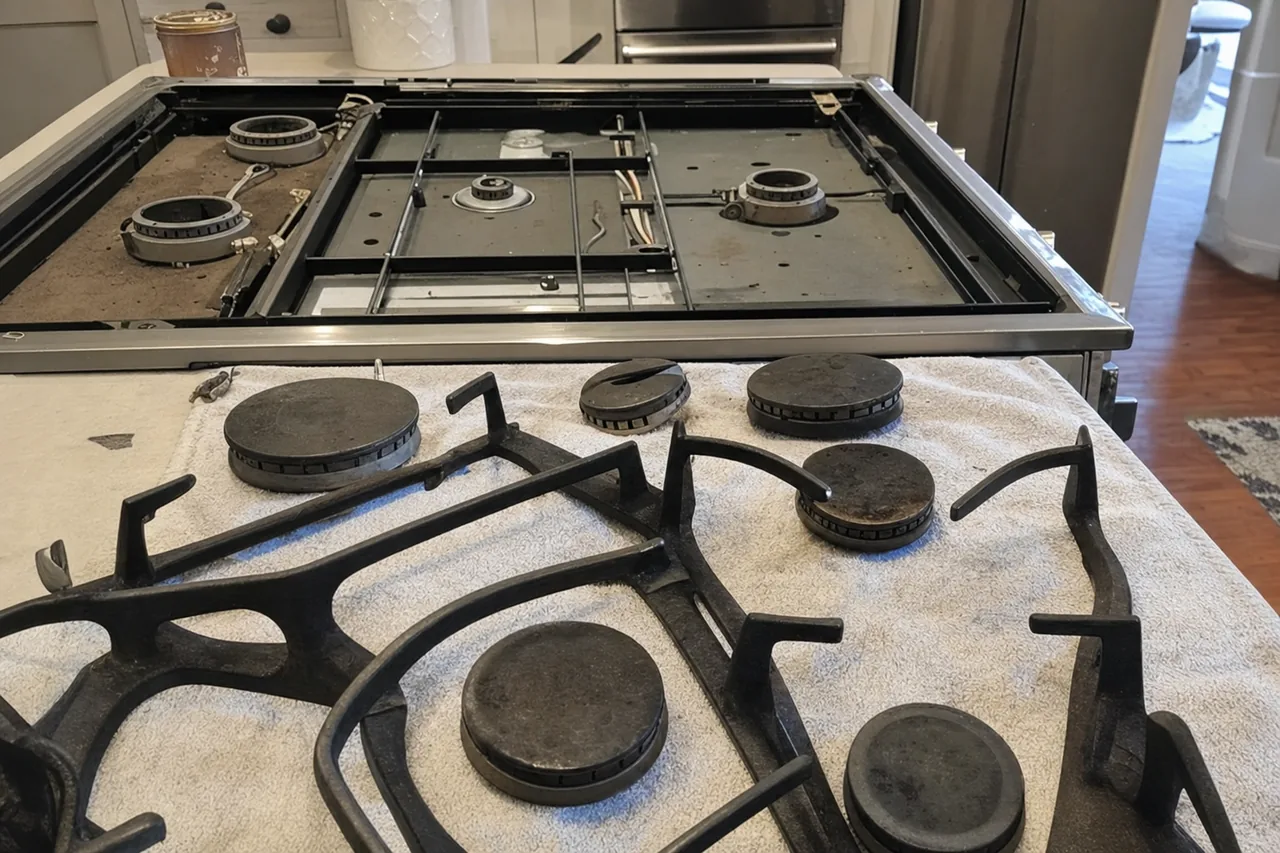
Thermador igniter clicking, yellow flame, burner will not light
Thermador’s star-shaped burner geometry spreads flame further out toward the pan edge than a conventional ring, which is why the burner caps and the port channels have to be seated and clean to work as designed. Two things spoil that here.
The first is spark. A burner that clicks and clicks without lighting usually has an igniter that is wet, greasy or salted over. Near the ocean, salt residue combines with cooking grease into a film that will not carry a spark cleanly. If every burner clicks whenever one knob is turned, that is normally a stuck switch or a shorted igniter, not six failed parts.
The second is port fouling. Fine sand and salt come through open windows all summer, settle in the burner ports, and turn a crisp blue flame yellow and lazy. A yellow flame is not just cosmetic — it means incomplete combustion, soot on your pans, and a burner that will not hold a low setting.
That low setting matters on this equipment. The extra-low simmer function cycles the gas valve rather than running a continuous tiny flame, and a burner with fouled ports or a marginal manifold pressure will drop out entirely during the off portion of that cycle. We check manifold pressure at the appliance before condemning any valve.
Where that lands on the price list is worth knowing before you call. A spark module or a replacement igniter is the igniter band on the table further down this page; a cap that needs seating, a port that needs clearing and a manifold that needs setting are part of the visit rather than a parts bill at all.
Induction — the failure is almost always heat, not the coil
Induction cooktops fail in a way that surprises owners. The glass and the coils are robust; the electronics underneath are not, and they are cooled by a fan that pulls room air through the cabinet.
In a beach kitchen that air is warm, humid and salty. The fan’s intake filter loads, the heat sink under the power board runs hotter, and the control protects itself by cutting power. The symptom is an element that works for sixty to ninety seconds at high power and then shuts down, or a cooktop that behaves perfectly in the morning and unreliably after an hour of cooking.
Before any board gets quoted we verify airflow through the cabinet, check the cutout for a blocked return path — a surprising number of installations bury the intake against a drawer back — and measure the supply voltage at the terminal block. A cooktop on a shared or undersized circuit produces intermittent shutdowns that look exactly like a failing inverter.
Cracked glass is the other induction call. Hairline cracks radiating from a single element are usually thermal, from a pan boiled dry or a heavy pot dropped on a hot surface. A cracked top is not repairable and must be replaced as an assembly; we will tell you that on the phone rather than charge you to hear it in person.
Radiant electric
Radiant elements fail open, and they fail obviously — the element simply stays cold while its neighbour glows. The more interesting fault is the touch control that responds intermittently. Capacitive touch panels dislike two things: moisture trapped under the glass edge and heat soaking up from a wall oven installed directly below. Both are common here, and both are diagnosable without guessing.
Installation faults we find on retrofits
In the older cottages in the 1st to 5th Street core, a modern cooktop has often been dropped into a counter cutout made for a 1970s unit. The result is insufficient clearance to combustible material at the sides, a rear wall too close, or no dedicated 40-amp circuit for an induction top that needs one.
We flag it when we see it. Fixing the appliance without fixing the installation buys you a repeat visit.
The visit
Flat $80 diagnostic, credited toward the repair. Written estimate before any part is ordered. Genuine OEM parts, 90 days on labor, 365 days on parts.
What it costs
What does cooktops and rangetops work cost here?
The bands below are the ones this repair actually falls into — parts and labour, fitted, read off the same table the pricing page prints in full.
| What was actually wrong | Parts and labour, fitted |
|---|---|
| The visit and the diagnosis | $80 flat |
| Igniter, spark module or surface element | $190–$500 |
| Control board or touch panel | $420–$1,020 |
| Bake or broil element | $190–$590 |
| Door hinge, glass or seal | $190–$640 |
The $80 buys the visit and the diagnostic sequence, and it comes off the bill the moment you approve the work. Every row below is a range because what a part costs turns on which production revision is sitting in your cabinetry, and nobody knows that until the rating plate has been read. The whole table is on the pricing page.
Cooktops and rangetops — asked on the phone
Why does a burner light and then drop out a second later?
The flame is lighting but the sensor is not being convinced that it did. A port blocked with spill, a corroded electrode, or a burner cap sitting a fraction out of place all leave the flame off the sensing element, and the gas valve closes again the moment the control stops seeing it.
My induction zone keeps shutting down under load. Is the coil dead?
Almost never. An induction hob throttles and then drops a zone when its own electronics get too hot, and that is a cooling problem: a fan choked with dust, a vent slot a cabinetmaker closed off, or an oven built in directly beneath with no gap. We look at the air path before the coil.
Every burner clicks when I turn one knob. Is that six dead igniters?
No. A spark module fires the whole set together, so one stuck switch or one shorted electrode makes the entire top click at once. The fault is a single component, and finding which one takes a meter across the switch bank rather than a box of igniters.
Is a grill or griddle module worth repairing on its own?
Yes, and it usually is. Elements, burner baffles and warped plates are discrete parts that come out without disturbing the rest of the appliance, so a module fault is one of the more contained repairs on a rangetop rather than a reason to look at the whole unit.
Cooktops and rangetops
What owners said after this repair
4.2 out of 5, across 74 customer reviews. What is printed below is one kitchen, one call and one invoice at a time, set down by the owner who settled it.
A radiant element had stopped glowing on one side of the glass. He lifted the top, found a burnt terminal at the element tail, and replaced the element with its lead. Neat work, and a week of waiting on the part.
Ottilie M.
Two burners on the rangetop would light and then die back within seconds. He cleaned the ports properly, changed an orifice that had corroded, and set the low flame by eye and by ear. No dropouts since that morning.
Terrance O.
One of the rear burners kept clicking long after it had lit. He found a cracked spark electrode and a damp igniter port, replaced the electrode, dried and resealed the cap, and the clicking has not come back.
Emmeline R.
$80 flat diagnostic, credited toward the repair. Full pricing · 90 days labor, 365 days parts · All repairs
Book a visit
A flat $80 diagnostic covers the visit and the diagnosis. It is credited toward the repair if you go ahead with the work.
You get a written estimate before any part is ordered or any labor begins. Nothing is opened up on a maybe. Labor is warranted 90 days. Genuine OEM parts are warranted 365 days from the date of installation.
- Monday – Friday
- 8:00am – 6:00pm
- Saturday
- 9:00am – 4:00pm
- Note
- Closed Sunday. Scheduled appointments only — no emergency or after-hours service.