Built-in refrigeration
Thermador column runs warm and never cycles off
Column refrigerators, freezer columns and built-in French door units — sealed system, defrost, ice production and door seal work.
What we work on
Thermador built-in refrigeration on this coast means three shapes: Freedom Collection columns installed side by side, a single built-in French door cabinet, and the panel-ready under-counter units that turn up in island bases and outdoor kitchens. The internals differ, but the failure list is short and predictable, and most of it comes down to two things — airflow and installation.
Thermador ice maker not making ice: the fill is what fails
Hollow cubes, thin shells and cubes that shatter when you drop them in a glass are the most common refrigeration complaint we take, and the ice maker itself is rarely the cause.
A fill valve meters water by time, not by volume. The control opens it for a fixed number of seconds and expects a known quantity through a known orifice. Any restriction upstream — a supply stop that was never fully opened, an inline filter left in past its interval, a blocked inlet screen, an orifice that has narrowed with deposits — delivers less water in the same open time. The mold takes a short fill, the water freezes against the mold walls and up the sides, and harvest sweeps a hollow shell into the bin.
Fit a new ice maker and it produces identical cubes on the first cycle, because it is fed by the same restricted supply. So we measure instead: a timed fill caught in a jug, inlet pressure at the valve, the screen pulled and inspected, and the mold surface checked for the chalk-white crust that says it has been running under-filled for a long time. Freezer temperature is verified at the same visit, because a compartment running warm changes everything downstream of it.
Three complaints look identical from the bin and are not. Undersized or hollow cubes, every cube and every cycle, are a fill problem. Full-size cubes fused into a slab are a harvest problem — the mold heater or the harvest motor, not the water. Normal cubes in insufficient numbers is a cooling problem, which loops back to condenser airflow. Ten minutes with a jug and a thermometer decides which of the three you are looking at, and the price table further down this page shows the band the repair then falls into.
Three shapes, three service realities
The internals are closely related across the range; the installation is not, and the installation is what decides how long a job takes.
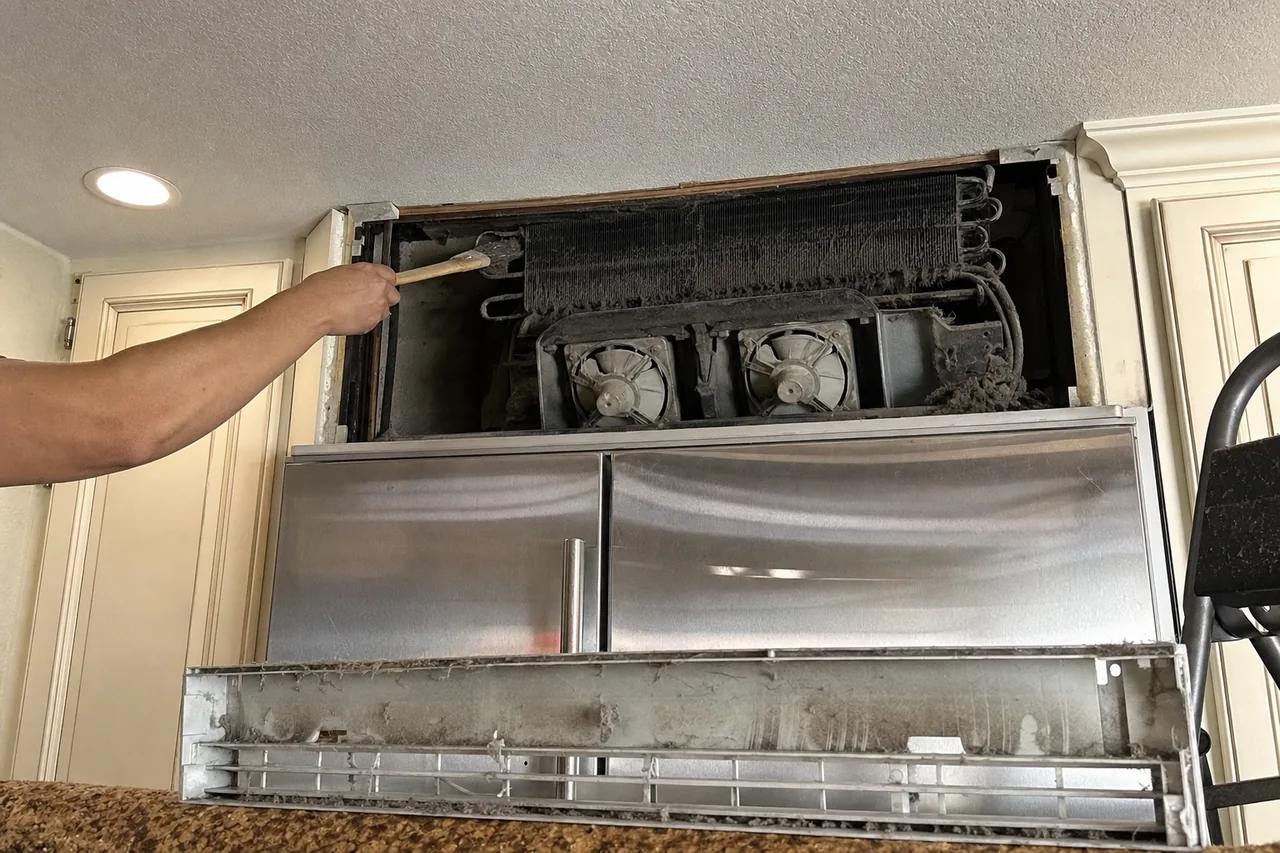
A full-height column comes forward on rails and needs its custom door panel and usually its door removed before it clears the opening. It is heavy, it is tall, and its condenser sits at the top behind a grille that has to be reachable — a crown moulding or a cabinet valance added after the install is a real obstruction.
A built-in French door cabinet carries its condenser underneath, behind the toe-kick grille, which is the grille most often covered by flooring added later. Its drain path is longer than a column’s and food debris matters more in it.
Panel-ready under-counter units are the easiest to reach and the least forgiving of their surroundings. A small coil in an island base with no rear or toe-kick clearance runs at a permanent disadvantage, and anything installed outdoors has to be an outdoor-rated cabinet in the first place — an indoor unit in a lanai surround fails in a way no repair prevents from recurring.
Salt air is the second half of the story
A built-in cabinet rejects heat through a condenser behind the grille, usually at the top on a column and underneath on a French door unit. It pulls kitchen air across those fins every minute the compressor runs.
Within a few blocks of the Atlantic that air carries salt, and salt is hygroscopic — it holds moisture against aluminium fins and turns ordinary dust into a paste that packs the gaps instead of blowing through. Heat rejection drops, head pressure climbs, and the compressor stops cycling off. The cabinet runs three or four degrees warm and never recovers.
That is an airflow problem, not a sealed-system problem, and it is why we always pull the grille first. Left alone for a year or two it becomes both, because a compressor running at elevated head pressure for months does not last.
Defrost, drains and the water under the drawers
Water standing under the crisper drawers has one of two causes. Either the evaporator drain is blocked, in which case defrost melt backs up over the drain pan lip and runs forward into the cabinet, or the defrost cycle itself is not completing and the evaporator has iced into a solid block that sheds water unevenly when it finally does clear.
We check drain flow directly, check heater resistance, and check the termination sensor. On a column, the drain path is short and steep and rarely blocks. On a built-in French door cabinet it is longer, and food debris matters.
Doors, hinges and panels
Full-height doors carrying custom panels are heavy, and beach houses see them opened wet-handed all summer. Hinge cams wear, the door drops a few millimetres, and the gasket stops making a full seal along the strike side. You see it as a sweating cabinet face and hear it as a compressor that runs longer than it should.
Hinge adjustment and gasket replacement are quick work when caught early. Once a dropped door has been dragging on the frame for a season, the trim and the panel mounting usually need attention too.
How the visit works
A flat $80 diagnostic covers the trip and the diagnosis, and it is credited toward the repair if you go ahead. You get a written estimate before any part is ordered or any labor begins. Sealed-system work — anything that opens the refrigerant circuit — is performed by EPA Section 608 certified technicians, because federal law requires that credential to handle refrigerant.
Genuine OEM parts only. Labor is warranted 90 days, parts 365 days from installation.
What it costs
What does built-in refrigeration work cost here?
The bands below are the ones this repair actually falls into — parts and labour, fitted, read off the same table the pricing page prints in full.
| What was actually wrong | Parts and labour, fitted |
|---|---|
| The visit and the diagnosis | $80 flat |
| Refrigeration column sealed system | $870–$2,290 |
The $80 buys the visit and the diagnostic sequence, and it comes off the bill the moment you approve the work. Every row below is a range because what a part costs turns on which production revision is sitting in your cabinetry, and nobody knows that until the rating plate has been read. The whole table is on the pricing page.
Built-in refrigeration — asked on the phone
Why does my column run constantly and still feel warm inside?
Nine times out of ten the condenser can no longer reject its heat. Salt-laden dust packs the fin gaps into a paste, the coil stops shedding heat, head pressure climbs and the compressor never reaches a temperature at which it can cycle off. It reads exactly like a dying compressor and it usually is not one.
Are hollow ice cubes a sign the ice maker needs replacing?
Rarely. The fill valve meters water by time rather than by volume, so anything that restricts the supply — a stop left part closed, a filter long past its interval, a narrowed inlet screen — delivers a short fill into the same open cycle. The mould freezes what it was given and the cube comes out hollow.
The ice maker has stopped making ice entirely. Is the ice maker gone?
Not usually. No ice at all is a supply or a harvest story rather than a dead mould: a stop left closed, an inlet line frozen at the valve, a harvest motor that has stalled, or a freezer compartment sitting above the temperature at which harvest will release. Fill and harvest are tested separately.
Can sealed-system work be done without pulling the cabinet out?
Usually not. Opening a refrigerant circuit means reaching the compressor and the process tubes, which on a built-in means the cabinet comes forward out of its opening. That is part of why we measure pressures and rule out airflow, defrost and door faults before anyone touches the seal.
Built-in refrigeration
What owners said after this repair
4.2 out of 5, across 74 customer reviews. What is printed below is one kitchen, one call and one invoice at a time, set down by the owner who settled it.
Our column had been running almost constantly since spring. He pulled the grille, found the coil packed with a grey paste of salt and dust, washed it properly and set the fan clearance. Run time halved within a day.
Silas E.
Interior lighting had died and the display was flickering with it. Rather than order a panel he checked the harness behind the hinge, found a chafed loom, and repaired the run. Everything works and nothing expensive went in.
Delphine K.
Milk was freezing in the fresh food compartment. He found the damper stuck part open and swapped it, then rebalanced the two setpoints. Fixed, though he had to come back with the part on a second morning.
Barnaby W.
$80 flat diagnostic, credited toward the repair. Full pricing · 90 days labor, 365 days parts · All repairs
Book a visit
A flat $80 diagnostic covers the visit and the diagnosis. It is credited toward the repair if you go ahead with the work.
You get a written estimate before any part is ordered or any labor begins. Nothing is opened up on a maybe. Labor is warranted 90 days. Genuine OEM parts are warranted 365 days from the date of installation.
- Monday – Friday
- 8:00am – 6:00pm
- Saturday
- 9:00am – 4:00pm
- Note
- Closed Sunday. Scheduled appointments only — no emergency or after-hours service.